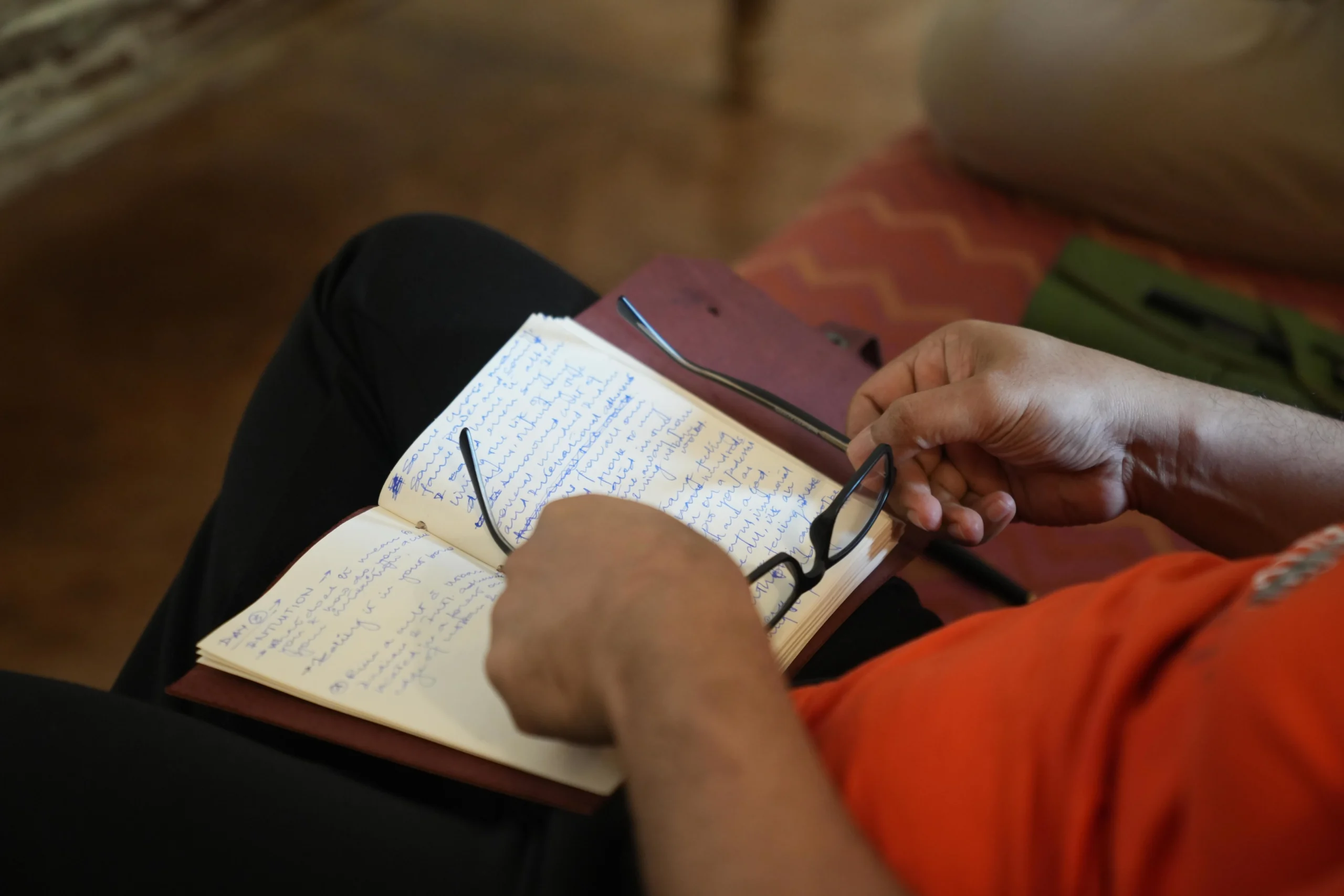
Midlife Crisis in Men: Causes, Signs, and the Quiet Questions That Emerge
Somewhere between the ages of 35 and 60, many men begin to notice a subtle shift. On the surface, life may be working. A career has taken shape. Family responsibilities
Borderlands | Retreats for men navigating a midlife crisis

Midlife rarely arrives as a dramatic crisis. More often, it shows up in small but noticeable ways.
You might find yourself feeling restless even when life looks fine from the outside. Getting irritated more easily, or feeling strangely flat. Going through the motions at work or in your relationships without quite knowing when that started. Finding it hard to say what you are actually feeling — or realising, with some surprise, that you don’t know. Feeling distant from your partner despite nothing being obviously wrong. Having moments where you feel unexpectedly alive, and then wondering where that goes.
And underneath all of it, a question that doesn’t quite go away: is this the life I actually wanted?
Drawing from real reflections of men navigating this phase, this article explores eight signs of midlife through the lens of head, heart, and gut. Not as problems to fix. As signals of a deeper shift — a phase where different parts of a man’s life begin asking to come back into alignment.
At Borderlands, we often explore experience through three interrelated centres: the head — thought, meaning, narrative. The heart — emotion, connection, relationship. The gut — instinct, energy, action.
These are not abstract ideas. They are lived dimensions of experience that show up in the body.
In earlier phases of life, one centre often dominates. The mind leads. Responsibility takes over. Instinct is managed, postponed, or quietly suppressed. For a long time, this works.
Midlife tends to be the phase where it stops working as well as it did.
Restlessness appears when one centre begins to move without the others. Tension appears when they fall out of alignment entirely. Many of the signs described below can be understood not as isolated problems, but as expressions of this deeper reorganisation — the three centres pressing, in their different ways, to be heard.
Midlife rarely begins as a dramatic rupture. More often, it arrives as a subtle but persistent unease — the kind that is difficult to name, and therefore difficult to address.
A 43-year-old entrepreneur based in Bangalore, running a growing logistics business while raising two young children, described it this way:
“Nothing is really wrong. Everything is… fine. But it doesn’t feel fully like my life anymore. It’s like I’m slightly outside of it.”
This restlessness often moves through all three centres at once. The head questions direction — the decisions made, the path taken, whether the narrative still holds. The heart grows flat or quietly disconnected, present but not quite engaged. The gut loses its spontaneity — the impulse, the aliveness, the sense of moving toward something.
Life continues to function. It just no longer feels fully inhabited.
Relationships at midlife often do not collapse. They change in ways that are harder to name — and therefore harder to address.
A senior finance professional in Mumbai in his late 40s, managing a large team while supporting both children and ageing parents, reflected:
“Earlier there was more friction… even anger. Now it’s calmer. But also more distant. We respect each other. We function well. But emotionally, we’re not really meeting.”
What he was describing is a particular kind of loss — not of the relationship itself, but of its texture. The head registers that the relationship is stable, even successful. The heart notices that emotional intimacy has plateaued. The gut registers a shift in polarity, in attraction, in the felt sense of wanting to move toward someone.
The relationship continues. It is felt differently from the inside.
By midlife, many men are holding multiple roles at once — professionally, domestically, emotionally — with very little genuine recovery built into any of it.
A 41-year-old corporate professional based in Gurgaon put it plainly:
“I feel mentally tired. Physically also tired. There’s always something — work, kids, home. There’s no real space to stop and feel anything.”
This fatigue is layered in a way that rest alone does not resolve. The head carries constant responsibility with no clear horizon. The heart has had little space for actual emotional processing — feelings are managed rather than felt. The gut runs on diminishing reserves, energy spent faster than it is replenished.
The system is active. It is not restored.
Externally, life may be stable — even successful by any reasonable measure. Internally, something feels removed. Not broken. Just far away.
“We love and respect each other. But emotionally we are not that close anymore.”
This gap — between functioning and feeling — is one of the most common and least spoken-about experiences of midlife. A man can look at his life and find nothing obviously wrong, while experiencing it as though through glass. Present, but not quite inside it.
It is not ingratitude. It is not weakness. It is a signal from a system that has been operating without replenishment for a long time.
A participant in his early 40s working in the technology sector in Bangalore said simply:
“I don’t express much. I don’t even know what I would say.”
There was a slight smile as he said it — the particular smile of a man who has noticed something about himself but hasn’t yet found the words for it.
From a Borderlands perspective, this is not a lack of feeling. The heart is often present, sometimes acutely so. What is missing is the pathway — the inner language, the permission, the practice of moving feeling outward. The head stays articulate. The heart remains unformed. And expression, which requires both, stays blocked.
Not because nothing is there. Because the route from inside to outside has not been used in a long time.
A creative professional from Delhi described particular moments that felt qualitatively different from the rest:
“When I’m in a real conversation — no rush, no roles — something opens up again. Like I remember a different version of myself.”
These moments carry presence, ease, a sense of genuine connection. They arrive unexpectedly — in a conversation, in nature, in a piece of music, in a moment of physical effort that empties the mind.
They are easy to dismiss as distractions or nostalgia. They are neither. They are signals from the gut — from the instinctive centre that knows what aliveness feels like and recognises it when it appears. The question they ask is not sentimental. It is directional: why is this rare, and what would it take for it not to be?
Midlife often produces a particular kind of internal contradiction — the experience of wanting things that appear to be in tension with each other.
A senior manager in his late 40s described it:
“I feel like I want to be present. But I’m pulled in different directions all the time.”
The head carries obligation — the structures, the commitments, the expectations that have accumulated over decades. The heart pulls toward meaning — toward something that feels more chosen, more real. The gut moves toward change — toward action, toward a different way of being — without yet knowing what that looks like.
This is not confusion. It is the texture of transition. The three centres pulling in different directions is not a sign that something is wrong. It is a sign that something is beginning to move.
Midlife brings a deeper question. Not what have I achieved? But what have I actually lived?
In a conversation on the Men Who Pause podcast, Gurcharan Das speaks about the difference between making a living and making a life. The distinction lands differently when you are standing inside it.
A business owner in his mid-40s from Bangalore reflected:
“I’ve done everything I was supposed to do. But I don’t know anymore if it’s what I really wanted. I don’t even know what I want now.”
This is not simply regret. Regret looks backward. What this man was describing looked both backward and forward simultaneously — a recognition that the map he had been following was drawn by others, and that somewhere in the following of it, his own sense of direction had gone quiet.
That quiet is not the end of something. It is often the beginning.
Midlife also introduces noticeable changes in the body — changes that are easy to pathologise and harder to understand.
Testosterone levels gradually decline with age, typically beginning in the mid-30s at roughly one percent per year. Long-term stress affects sleep, mood, and recovery. The body that once absorbed pressure and bounced back begins to ask for something different.
Men may notice reduced physical energy, slower recovery, sleep disturbances, a shorter fuse. These are real, and they are worth attending to. But they are not only decline.
The gut centre — the centre of instinct, vitality, and energy — is asking for a different relationship. Not for less, but for something more considered. Many men in their 40s take on long-distance physical challenges for the first time: endurance running, cycling, swimming. They draw less on intensity and more on consistency. The body reorganises around depth rather than speed.
For many men, midlife becomes the first time they build a conscious relationship with their own physicality — not to perform, but to inhabit.
In our work at Borderlands — where we host retreats for men navigating midlife — participants often share what’s already present for them before they arrive. Across these reflections, similar themes appear with striking consistency.
Many men reach midlife with professional competence and outward stability firmly in place, and very little language for what is shifting underneath. The work draws from psychology, somatic practice, contemplative traditions, and lived group experience — environments where the questions midlife raises can be explored with others who are asking the same things.
What we have observed, consistently, is this: midlife tends to move differently when it is not carried alone.
Midlife is not always a crisis.
Sometimes it begins as a quiet cracking — a sense that the life you have built no longer fits in the same way it did. It becomes a crucible — where questions that have been deferred for years can no longer be deferred. And if engaged with honestly, it becomes a crossing — into a way of living that is more conscious, more chosen, more genuinely one’s own.
The signs described in this article are not diagnoses. They are invitations. The question is not whether you are experiencing them. It is what you are willing to do with what they are pointing to.
Most commonly between 35 and 50, though the edges are not fixed. For some men the shift begins in the late 30s — a quiet restlessness beneath a life that looks, from the outside, entirely intact. For others it arrives later, often triggered by a structural change: children leaving, a career plateau, the illness or death of a parent. The age matters less than the recognition — the moment when the life you have been living begins to feel like it is asking a question you can no longer ignore.
It is not a clinical diagnosis in the traditional sense. But the experience it describes is real, well-documented, and widely observed across cultures. Carl Jung wrote about the second half of life as a fundamentally different psychological task — less about building and achieving, more about integrating and becoming. What many men experience in their 40s is not dysfunction. It is the pressure of that task arriving, often without warning, in the middle of an otherwise functioning life.
Often, yes. The restlessness of midlife is uncomfortable precisely because it is honest — it tends to surface what has been avoided, deferred, or quietly suppressed. Men who engage with that discomfort rather than acting it out or shutting it down often emerge with a clearer relationship to what they actually value, what they want from relationships, and who they are outside of roles and responsibilities. The transition is rarely comfortable. It is frequently clarifying.
There is no single answer. For some the shift moves through within a year or two. For others it marks the beginning of a longer process of change that reshapes not just behaviour, but identity. What tends to determine the duration is less the intensity of the experience and more how consciously it is met. When the underlying questions are explored — through reflection, honest conversation, therapy, or structured support — the transition tends to move. When they are avoided or acted out impulsively, they tend to linger, circling the same territory without resolution.
Consistently. The internal shift that midlife produces rarely stays internal — it shows up in tone, in presence, in the quality of attention a man brings to his closest relationships. A partner often notices the change before it is named. The relationship may not collapse, but its texture changes: conversations that once felt easy become difficult, intimacy requires more effort, distance becomes the default. Whether this leads to repair or rupture often depends on whether the shift is acknowledged and explored, or left to operate underground.
They can overlap, and it is worth taking both seriously. Depression tends to present as a persistent low mood, a loss of interest in most activities, difficulty functioning, and a sense of hopelessness that doesn’t lift. Midlife crisis tends to present as restlessness, questioning, a search for something — energy that has lost its direction rather than energy that has gone. A man in midlife often still feels things acutely, still has moments of aliveness, still functions. If low mood is persistent, pervasive, and accompanied by difficulty sleeping, eating, or carrying out daily life, a conversation with a mental health professional is the right first step.
Most don’t. And the isolation that produces — the sense of being the only one navigating something with no clear name — is itself one of the harder aspects of the transition. What tends to happen in environments where men do speak about this openly, whether in therapy, close friendships, or retreat settings, is a rapid recognition: these patterns are not personal failure. They are common, human, and navigable. Hearing another man describe the exact texture of something you thought was yours alone is often the beginning of something shifting.
Midlife is not necessarily a breakdown.
It is often the moment where life begins to ask different questions — about what has been built, what has been lived, and what still remains possible.
How those questions are met can shape everything that follows.
Somewhere between the ages of 35 and 60, many men begin to notice a subtle shift. On the surface, life may be working. A career has taken shape. Family responsibilities

I recently began reading Meeting the Shadow—a book Qusai gave me so I could deepen my understanding of Shadow Work, one of the practices we use at Borderlands. I expected
Over the last year, 560 men have reached out to Borderlands. We’ve spoken with more than 300 — sometimes for hours, sometimes for minutes that felt like years. These weren’t